

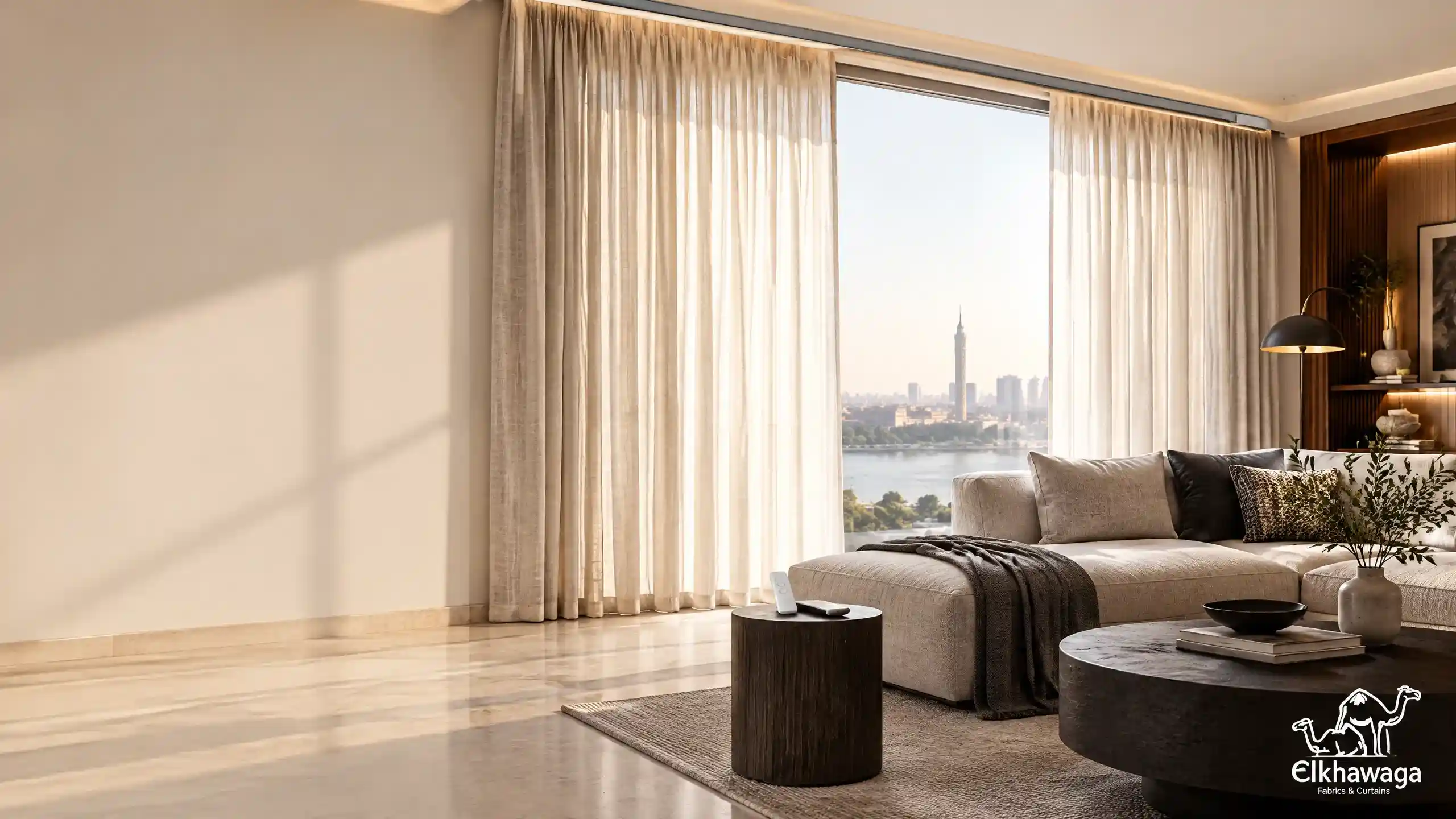
Smart curtains and Motorized Window Treatments are curtains or shades moved by a concealed motor instead of by hand. In an Egyptian home, the best system is not necessarily the one with the most features. It is the combination of a suitable track or shade, fabric that handles sun and dust, dependable power, and controls your family will use. This guide explains the decisions to make before requesting a measured, customised quotation from El Khawaga Fabrics and Curtains.
What makes a curtain “smart”?
A motorized window treatment uses an electric motor to open, close, raise, lower, or tilt a curtain, blind, or shade. “Smart” usually means the motor can also respond to a remote, wall switch, app, voice assistant, schedule, or sensor. Some products are motorized but not connected to a network; others need a separate hub or gateway to communicate with an app or smart-home platform.
The motor is only one part of the installation. A complete system may include the fabric, track or roller tube, motor, power supply, controls, mounting hardware, and programming. Commissioning means setting travel limits, grouping windows, and testing operation after installation. Ask who provides each part.
Why consider motorized curtains in an Egyptian home?
Convenience at difficult windows
Motorization is particularly useful for tall, wide, high, or obstructed windows. One control can close several curtains together, while a group control can operate a room or complete façade. You can also stop a shade at a chosen position.
Control of sun, glare, and privacy
East- and west-facing windows can receive strong low-angle sun. A schedule or sensor-assisted system can close the treatment before the room becomes uncomfortable, then reopen it when softer daylight is useful. Window attachments can reduce glare and unwanted solar heat gain while preserving some daylight; the U.S. Department of Energy identifies interior shades and blinds as tools for managing solar gain and daylight. This is not a promise of a fixed electricity saving. Results depend on glass, orientation, fit, fabric, air-conditioning habits, and consistent use.
Safer, cleaner operation
A motor can remove dangling operating cords. That matters where children or pets live. The U.S. Consumer Product Safety Commission says the safest option around young children is cordless window covering and warns that existing cords can cause strangulation. Motorization does not automatically make every installation safe: keep power leads tidy, prevent accessible loops, and confirm the product’s safety design for the room.
Main types of motorized window treatments
|
Type
|
How it moves
|
Common use
|
Key question
|
|
Motorized curtain track
|
A motor pulls fabric carriers along a track. Curtains can meet centrally or stack to one side.
|
Large glazed openings, balconies, and layered curtains.
|
Is there space for the track, stack-back, and serviceable power?
|
|
Motorized roller shade
|
A motor turns a tube to raise or lower fabric.
|
Clean-lined bedrooms, offices, kitchens, and shallow reveals.
|
Do you need light-filtering, privacy, or room-darkening fabric?
|
|
Motorized Roman shade
|
A motor lifts fabric in structured folds.
|
A softer, tailored appearance.
|
Can the fold package clear the window and remain cleanable?
|
|
Motorized blind
|
The motor raises, lowers, or tilts slats or vanes, depending on the design.
|
Adjustable daylight and privacy.
|
Which movements are motorized, and what happens in a power cut?
|
A bright living room may benefit from two independently controlled layers: a sheer or light-filtering layer for daytime privacy and a denser curtain for evening use. Each layer should have a clear job.
Choose fabric and lining around the motor
Select hardware with the finished treatment in mind. A wide, fully lined curtain creates a different load from a light panel. Confirm the system’s stated load, width, fabric fullness, and mounting limits with the installer. Do not infer capacity from a motor’s appearance.
For hot, dusty conditions, consider the following:
•Sun exposure: Ask about colour stability, lining choices, and suitability for a highly exposed window. Avoid claims that any fabric is completely fade-proof.
•Cleaning: Dust settles in folds and on tracks. Choose a construction that can be gently vacuumed, removed for professional cleaning, or maintained according to its care label without damaging the motor.
•Light level: Light-filtering fabric softens glare while keeping a brighter daytime feel. A room-darkening or blackout construction may suit bedrooms and screens. The result also depends on side gaps, overlap, track, and installation.
•Hanging and clearance: Measure the reveal, ceiling, handles, furniture, obstacles, and stack-back position. A motor does not correct poor fullness or a curtain catching on a handle.
•Layering: If sheers and drapes are both needed, confirm whether this requires two tracks, motors, and control channels.
Keep the motor protected from dust and moisture. Ask how it is accessed for inspection and which cleaning products are safe. Never spray liquid onto it.
Compare control options before buying
Control choice often affects satisfaction more than a long feature list. A remote may suit one room, while a wall switch is easy for visitors to find. An app or hub can coordinate scenes but introduces network dependencies. Voice control is useful as an extra, not as the only way to close a bedroom or restore privacy.
|
Control
|
Strength
|
Verify first
|
|
Handheld remote
|
Simple operation without a phone.
|
Range, channels, grouping, and battery type.
|
|
Wall switch
|
Easy to locate and share.
|
Wiring, position, and motor compatibility.
|
|
App or hub
|
Schedules, scenes, and multi-room control.
|
Internet dependence, local control, account requirements, and support.
|
|
Voice assistant
|
Hands-free operation.
|
Supported platform, privacy settings, room names, and physical backup.
|
|
Sensor or automation
|
Can react to time or sunlight.
|
Included sensor, placement, and adjustable thresholds.
|
Control ecosystems vary. Somfy’s educational catalogue, for example, lists handheld transmitters and TaHoma switch products for its shading solutions. This illustrates control categories, not a claim of local availability. Ask the Egyptian installer to state the exact motor, protocol, app, warranty route, and replacement plan in writing.
Safety, power, and installation checks
A good quotation should cover the site survey, measurement, mounting, electrical work, programming, user training, and after-sales service. Confirm the power location and whether a battery option suits the treatment.
Plan for a power cut. The system should have a clear manual override, safe stop behaviour, or another agreed operating method. Do not assume that an app will work when the router, hub, or electricity is unavailable. In a child’s room, test that no accessible cord, chain, or loop remains. Keep beds, cots, and climbing furniture away from residual cords, following CPSC guidance.
For new construction or renovation, discuss concealed wiring before plastering or cabinetry is finished. PNNL building guidance recommends pre-wiring windows when motorized and automated shading may be needed later. In an existing home, retrofit may still be practical, but track depth, socket position, wall strength, and visible cable routes must be checked.
What determines the cost?
Do not compare motorized curtains by a single advertised figure. A custom quotation can change with window count and size, treatment type, fabric and lining, fullness, motor load, power, mounting difficulty, controls, smart-home integration, electrical work, access, programming, and after-sales support. Special shapes and heavy fabrics can increase complexity.
Request the same scope from each supplier: fabric, finished dimensions, motor, power, controls, installation, programming, warranty, exclusions, and service process. Prices should be confirmed locally and in writing; this guide intentionally does not invent a price range or imply stock availability.
A practical selection sequence
Start with the window’s problem: glare, privacy, heat, hard access, sleep, or coordinated appearance. Choose the treatment and fabric layer that solves it, then confirm load and dimensions with an installer. Request a quotation and demonstration of movement, manual override, grouping, cleaning access, and safety.
FAQ Motorized Window Treatments
Are smart curtains worth it for a small flat?
They can be, especially at a hard-to-reach window or where several treatments move together. For one accessible window, a well-made manual curtain may be simpler. Compare convenience with motor, power, control, and service requirements.
Can I motorize existing curtains?
Sometimes. The existing track, carriers, curtain weight, fullness, mounting strength, and clearance must suit the motor kit. An installer should inspect it before promising conversion. Reusing fabric may still require new carriers or heading alterations.
Do motorized curtains work without Wi-Fi?
Many systems operate by remote or wall control without Wi-Fi, but the answer depends on the motor and protocol. App scenes, voice commands, and remote access may require a hub or network. Ask for a non-phone backup and test it during commissioning.
What is the best fabric for a sunny Egyptian room?
There is no universal best fabric. Match the layer to the job: light-filtering for softened daylight, a denser lined layer for privacy or darkness, or both for flexibility. Verify care requirements, sun exposure suitability, side gaps, and motor load before choosing by appearance alone.
Smart curtains work best when automation is matched to the window, fabric, climate, and household routine. Focus first on the problem, then specify motor, power, controls, safety, and service as one system. To explore fabrics, curtains, and made-to-measure customization, browse El Khawaga Fabrics and Curtains or speak with the team about your windows and preferred control setup.
Browse the Cushion Collection from Elkhawaga
Don’t miss out on the opportunity to visit our El Khawaga Fabrics branches